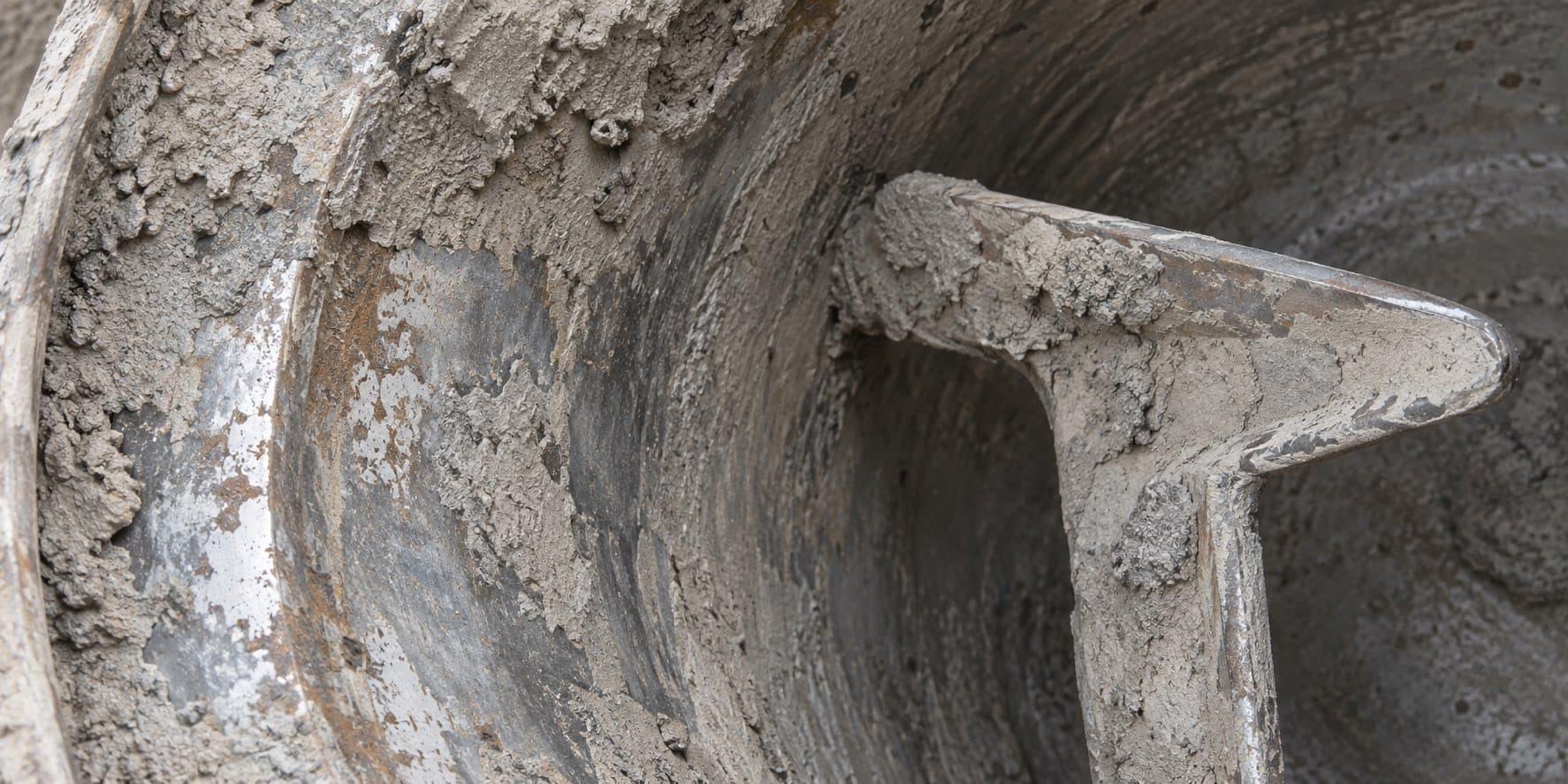
Concrete that has set on a paddle, a mould or the side of a tipper stops being a question of appearance the moment it starts changing the geometry of the tool. A growing layer reduces drum capacity, jams mould catches and speeds up corrosion underneath - and chipping it off with a hammer does the rest.
Preparations for this work fall into two groups that cannot be swapped: those that remove what is already there, and those that stop it sticking. Most of the saving is in the second.
Four different soils, four different preparations
Hardened concrete and mortar residue.
A hard, set layer. Manufacturers make concrete and cement residue removers for it.
Cement laitance.
A thin, cloudy deposit. A different preparation from set concrete, and usually milder.
Bitumen and asphalt.
Entirely different chemistry. Concrete removers will not touch it.
Corrosion and sticking.
Prevention rather than cleaning - applied before the work, not after.
What for what - the catalogue
Guard Industry runs four cleaners here with clearly separated uses: GTR Premium for concrete and cement residue, GTN for concrete deposits on equipment, GTL for cement laitance and GBR for bitumen and asphalt.
The fifth is GT VG MAX, an anti-corrosion preparation its manufacturer describes as intended for raw and worked metals and for equipment in storage or transit. That is the second group: it works before, not after.
Quick match
| What is on the equipment | Where to look | Note |
|---|---|---|
| Set concrete, thick build-up | Concrete and cement residue removers | The older the layer, the longer the dwell time in the sheet |
| Fresh concrete deposit after a shift | Concrete deposit removers | Cheapest to deal with on the same day |
| Cloudy film, cement laitance | Cement laitance removers | A different preparation from set concrete |
| Black, greasy marks from road work | Bitumen and asphalt removers | Concrete removers will not touch it |
| Rust, equipment standing idle | Anti-corrosion preparations | Applied before storage, not after |
Preparations for site equipment
Five Guard Industry products, each with the scope of use its manufacturer states.
- Premium
Concrete and cement residue remover GTR Premium - Guard Industry
329,00 zł
49,16 zł/L
- Premium
Cement laitance remover for site equipment GTL - Guard Industry
1465,00 zł
58,60 zł/L
- Premium
Corrosion protection for site equipment GT VG Max - Guard Industry
2758,00 zł
110,32 zł/L
- Premium
Bitumen and asphalt remover GBR - Guard Industry
763,00 zł
152,60 zł/L
- Premium
Concrete build-up remover for site equipment GTN - Guard Industry
1465,00 zł
58,60 zł/L
Before you use it: two things from the sheet
The substrate. The data sheet lists the materials a preparation may be used on. Aluminium, painted metal and galvanised surfaces are sometimes excluded - if your material is not on the list, do not assume it is covered.
Dilution and time. Both are stated by the manufacturer and both differ with the thickness of the layer. On every product those figures are in the technical data tab, under the name of the manufacturer they came from.
For businesses
Equipment is cleaned on a cycle rather than once, which makes this a shelf where the price per litre in a larger pack and a shared order history actually matter. A company account brings wholesale prices once approved, a shared order history for the whole crew, and reordering in one click.
Applying creates the account immediately; if wholesale terms do not go ahead, the account stays and you buy at list prices. See the terms.
Common questions
Will hydrochloric acid not do the same job?
It is sometimes effective on concrete and it is cheap, but it is hard to control: the concentration is arbitrary, the fumes are aggressive, and on metal it can do more harm than good. Catalogue preparations come with a dilution, a dwell time and a list of permitted substrates stated by the manufacturer - that is the difference.
How do I remove concrete that has been setting on equipment for months?
Data sheets give longer dwell times for thicker layers and usually allow the treatment to be repeated. On very old build-up, taking it off in stages rather than in one go is often the realistic approach.
How does a laitance remover differ from a concrete remover?
In scope and strength - laitance is a thin deposit, set concrete a hard layer, and manufacturers make separate products for them. The scope of use for each is in its data sheet.
Does an anti-corrosion preparation replace cleaning?
No - it is a different role. The manufacturer describes it as protection for equipment in storage or transit, that is something applied to clean equipment before it is put away. On dirty equipment it will not work.