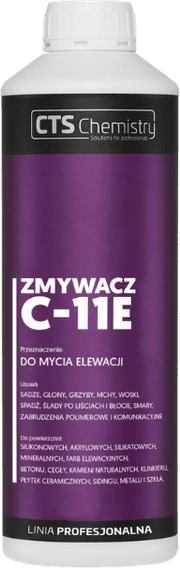
Facade and render cleaner C-11E CTS Chemistry

Washes atmospheric soiling, algae and organic deposits off facades in render, brick, clinker, stone and concrete. Dose the alkaline concentrate to suit the job: from 30 ml per litre of water for light soiling up to 400 ml per litre for heavy, and a pressure washer needs only 10-20 ml per litre.

Surface

Facades and roofs

See the whole range
Product image: Facade and render cleaner C-11E CTS ChemistryFacades and roofs

C-11E is an alkaline cleaner for washing facades and render. It is the counterpart of the roof cleaner C-11D - the same chemistry with a wider dilution range: for heavy soiling up to 300-400 ml per litre of water.

It removes atmospheric soiling, green algae growth and other organic deposits from render (silicone, acrylic, silicate and mineral), facades painted with facade paint, brick, clinker, natural stone and concrete. pH of the concentrate approx. 11.5, of the working solution approx. 9-10.

Work at 5-30 °C. Wet the wall with clean water, apply the solution with a sprayer, foam lance or brush, and after 2-3 minutes rinse thoroughly. A pressure washer needs only 10-20 ml of product per litre of water - first check on a small area how the facade copes with the pressure, and if the jet damages it, wash by hand. Before washing the whole wall, test in an inconspicuous place - on a facade the difference in shade after washing can be as visible as the soiling was.
On a facade the order of work matters as much as the product itself: a sealer applied over live algae seals them in.

  1. Wash the surface with a cleaner matched to the soiling: algae and moss need an alkaline product, efflorescence an acidic one.
  2. Rinse thoroughly and let the wall dry all the way through. After pressure washing that is usually days, not hours.
  3. Repair joints and cracks. A sealer is not a sealant and will not close a crack.
  4. Mask joinery, glazing and planting at the foot of the wall.
  5. Work upwards. Product running down a dry wall leaves marks that cannot be evened out afterwards.

Work out of direct sun and with a forecast free of rain. How long the fresh coat has to be protected from rain is given in the product's technical data.

Before treating the whole wall, test on an inconspicuous patch, behind a downpipe for instance. The same product can read differently on two batches of the same material, and on a surface with old coating left on it, it will not bond at all.

Coats
1
Application method
hand sprayer, foam lance, brush (stiff), mop, pressure washer
Dilution
By hand: light soiling 30-50 ml per litre of water, moderate 100-200 ml/l, heavy 300-400 ml/l. Pressure washing: 10-20 ml/l.
Application temperature
+5 to +30 °C
Where to use
outdoors
Form
concentrate, alkaline solution
Density
approx. 1 kg/dm³
pH of the concentrate
approx. 11.5
pH of the working solution
approx. 9-10
Note
test in an inconspicuous place before washing; before using a pressure washer, check on a small area how the facade copes with the pressure - if the jet damages it, wash by hand
Recommended substrates
silicone, acrylic, silicate, mineral and silicone-silicate render, facades painted with facade paint, concrete, brick, natural stone, clinker brick, ceramic tiles, siding, metal, glass
Preparation
wet the surface with clean water and wait 1-2 minutes
Dwell time
2-3 minutes, then rinse thoroughly with clean water
Do not use on
materials that are not resistant to alkalis
Will a facade sealer trap moisture in the wall?

No. Water-repellent products limit the ingress of water from outside but leave the pores open to water-vapour diffusion, so the wall can still release moisture.

What do I do about green growth on the facade?

Wash it off first with a product for organic soiling, rinse thoroughly and let the wall dry, then seal. Sealing without washing traps the growth under the treatment.

Can I seal roof tiles?

Yes - choose a product with roof tiles on its list of recommended substrates. Before sealing, wash them while the surface is cool - early or late in the day, never in full sun - and let them dry.

Will sealing improve the insulation of the wall?

No - that is not a sealer's job. It acts on the water uptake of the surface, not on heat transfer through the structure.

How do I turn a dilution ratio into a quantity?

A 1:4 dilution means one part product to four parts water - a litre of concentrate gives five litres of working solution. Where the ratio is given in ml per litre of water (the C range), work the other way: 50 ml per litre means 20 litres of solution from one litre of concentrate.

Should I wash the whole facade or just the dirty part?

The whole wall. A washed section against an unwashed one stays visible as a lighter patch - the commonest mistake when cleaning facades in spots.

What about plants at the foot of the wall?

Cover them before work and rinse with water afterwards. The product at working strength has a pH of 9-10.

How much will you need?

Consumption depends on how absorbent the surface is and how you apply the product.

Write to us with the area and the type of surface - we will help you work out how much you need.

Customer reviews

No reviews yet

Bought it from us? Tell us how it works on your surface. It helps others choose.

Review it in your account

Every review is linked to an order, so only people who bought this product in our shop can write one.

Looking for another surface?