When sealing goes wrong - patchy, uneven, or gone after one season - the cause almost always lies before the preparation went on, not in the preparation. The substrate was dirty, wet, too fresh or too cold. Here are five things to check, in the order in which they matter.
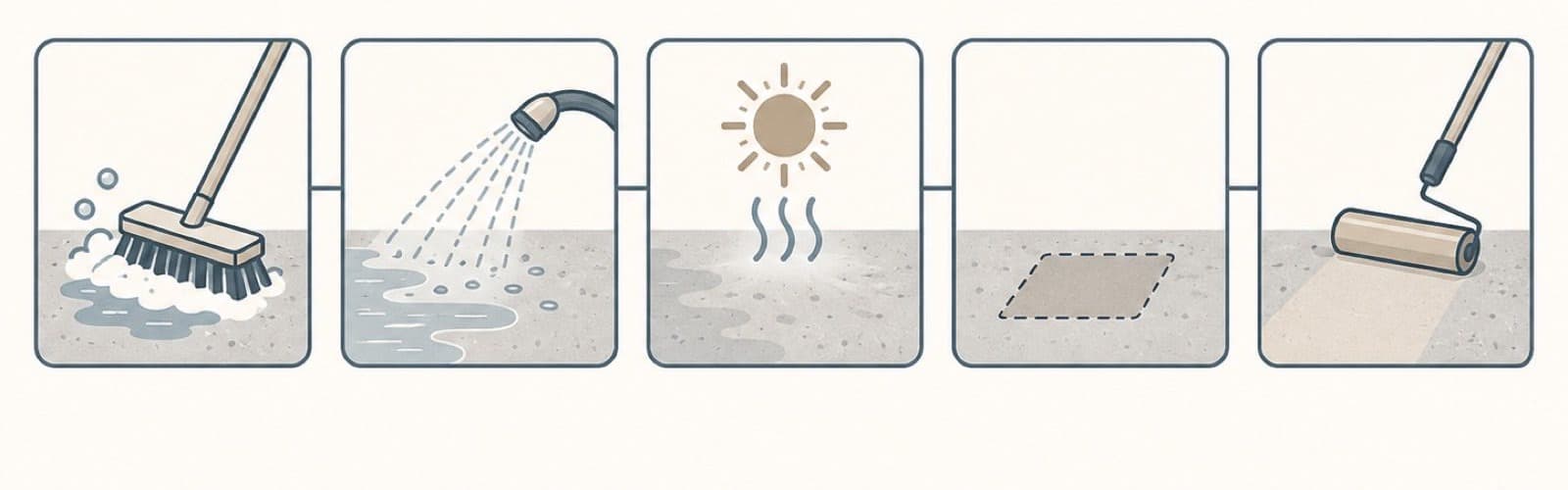
Five conditions, in order
Clean
A sealer soaks in together with whatever it finds. Efflorescence, cement laitance and grease have to go first.
Dry
Not 'dry on the surface' but dry in the pores. Manufacturers state a maximum substrate humidity.
Cured
Fresh concrete and paving have to give up their mixing water - data sheets say up to 28 days.
Within the temperature window
Every preparation states a minimum and a maximum; outside it the manufacturer stands behind nothing.
Tested on a patch
One slab somewhere out of sight settles what no description can.
1. Clean - because a sealer fixes what it finds
This is the condition that costs the most when it is skipped. The preparation soaks into the pores together with bloom, grease and dust, and then shuts them in underneath. Removing a stain from under a sealed layer means stripping that layer.
Different soils need different preparations and they do not substitute for one another: lime efflorescence is dissolved with an acid, greasy stains with a degreaser, and cement laitance from the build has a product of its own. If you have several problems at once: grease first, mineral deposits second, then rinse.
2. Dry - deeper than it looks
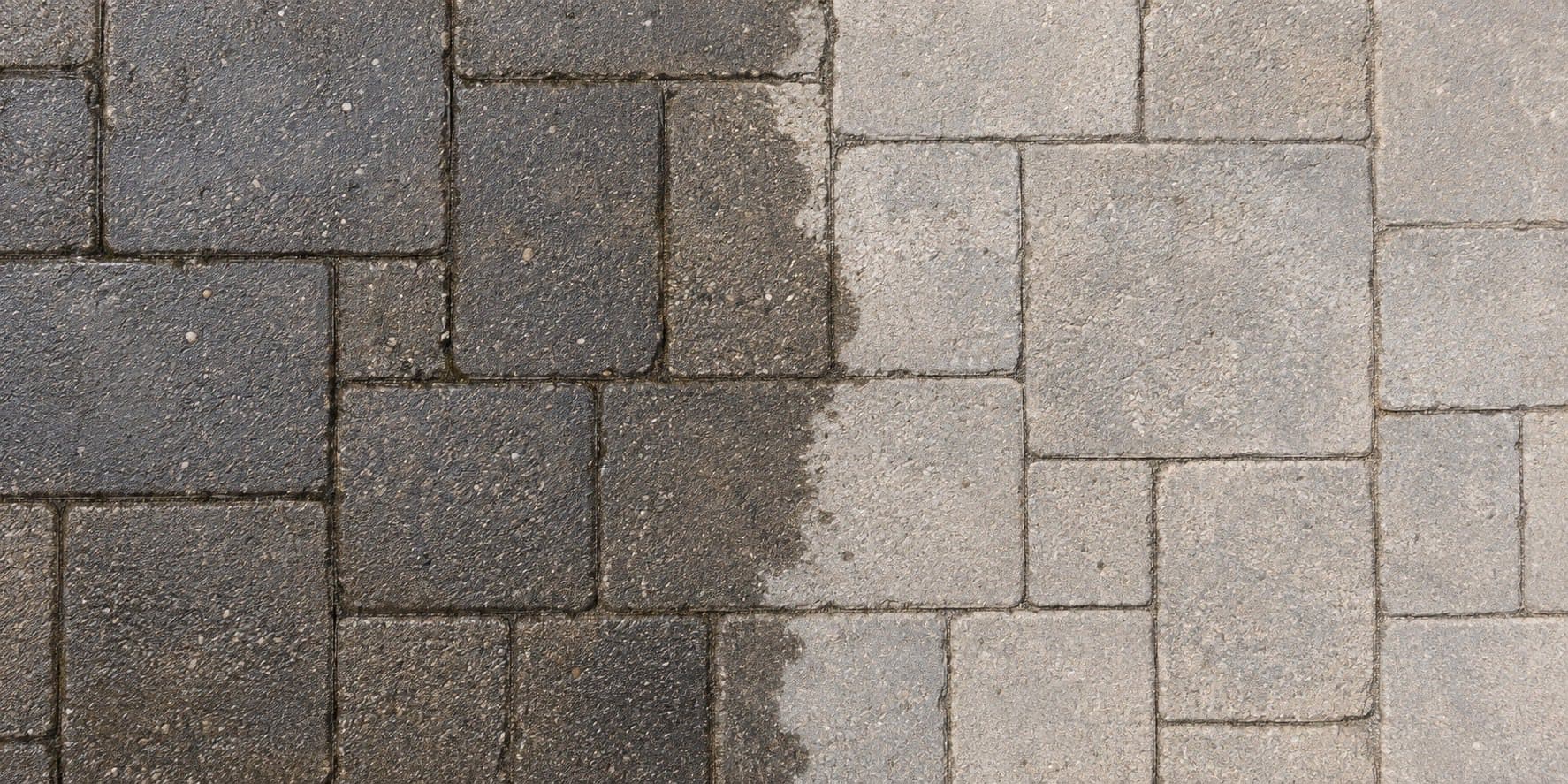
A surface can look dry while the pores are still full of water after washing or rain. A sealer that meets wet pores does not penetrate the way the manufacturer assumes - hence patches and an uneven finish.
Manufacturers state a maximum substrate humidity in their data sheets, and on every product in our catalogue that figure is in the data tab together with their name. Where a sheet does not state it, neither do we.
How long to wait before you start
| Situation | What you are waiting for | Where to check |
|---|---|---|
| Freshly laid paving or poured concrete | Substrate curing | The sealer's data sheet, 'substrate curing' field |
| After washing with a chemical preparation | Rinsing and full drying | The cleaner's data sheet - dwell time and how to rinse |
| After rain | The pores drying, not just the surface | Maximum substrate humidity in the sealer's sheet |
| A second coat of sealer | The interval between coats | The sealer's data sheet |
3. Cured - fresh concrete is still working
For many weeks after laying, concrete and concrete paving give up their mixing water. A sealer applied too early closes that route, and the result is sometimes efflorescence trapped under the layer.
The number of days differs between products and cannot be generalised - for some preparations in our catalogue the manufacturer states 28 days. Always take it from the sheet of the preparation you will actually be using.
Preparations for getting the substrate ready
What you wash and degrease with, before the sealer is opened.
- Standard
Anti-slip treatment for granite and gneiss tiles R-9G CTS Chemistry
59,90 zł
59,90 zł/L≈ 9,22 zł/m²
- Standard
Anti-slip treatment for ceramic and porcelain tiles R-9C CTS Chemistry
59,90 zł
59,90 zł/L≈ 11,98 zł/m²
- Standard
Oil stain remover for concrete and paving OL-1 CTS Chemistry
55,20 zł
55,20 zł/L
- Standard
Heavy-duty mineral soiling cleaner D-4 CTS Chemistry
40,16 zł
37,64 zł/L
- Standard
Lime efflorescence remover D-2W CTS Chemistry
35,67 zł
30,50 zł/L≈ 7,63 zł/m²
- Standard
Post-construction residue cleaner D-2B CTS Chemistry
49,20 zł
40,59 zł/L≈ 10,15 zł/m²
5. The test patch - fifteen minutes that save a weekend
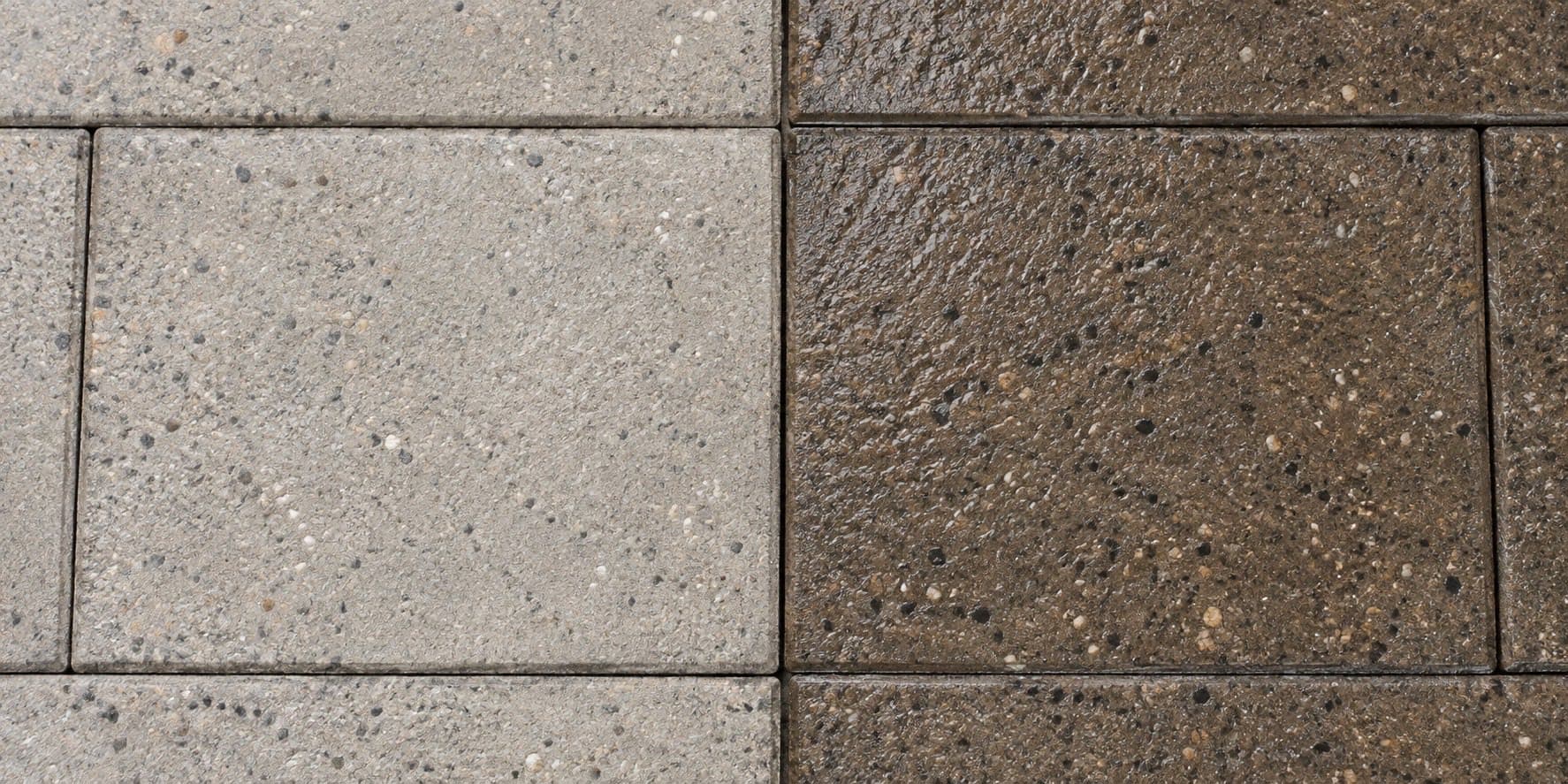
No description, ours included, can tell you how your particular paving will react to a particular preparation. Material varies by batch, by age and by what has been on it already. Put the preparation on one slab somewhere not visible from the street and judge it once fully dry - not before, because a wet substrate looks different.
With wet-look sealers the test is not optional, because the effect cannot be undone.
Common questions
Does paving that looks clean still need washing?
If it is new and carries no bloom or building residue, chemical washing is not necessary. Sweeping off sand and dust is still worth it - that is usually what separates even absorption from uneven absorption.
How do I check the substrate is dry enough?
A simple test is taping a sheet of plastic down for a few hours: condensation underneath means the pores are still damp. That is a rough method - where a manufacturer states a maximum humidity as a percentage, a moisture meter is what settles it.
Can I seal in full sun?
Manufacturers generally advise against working on a hot surface, because the preparation evaporates before it penetrates. Each states its own upper temperature limit in its data sheet.
Is a second coat necessary?
That depends on the preparation and on how absorbent the substrate is - the number of coats is one of the fields in the data sheet, and we state it on every product page in the data tab.
What should I do if the sealer came out patchy?
Establish the cause first, because it decides whether another coat will even it out or whether the preparation has to come off. Uneven absorbency, damp pores and leftover soiling each look different. Write to us with a description and a photograph - we answer within 24 hours.