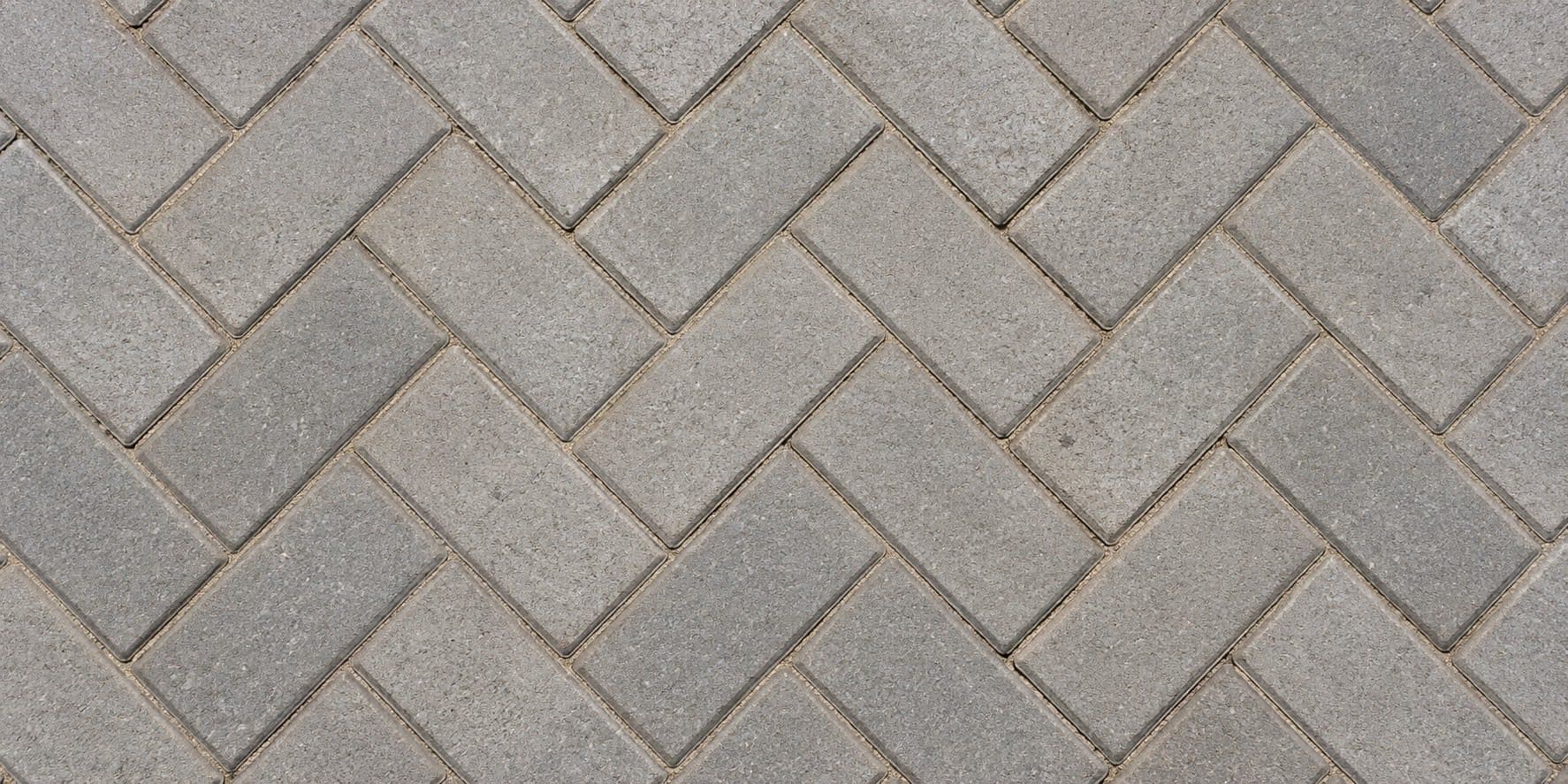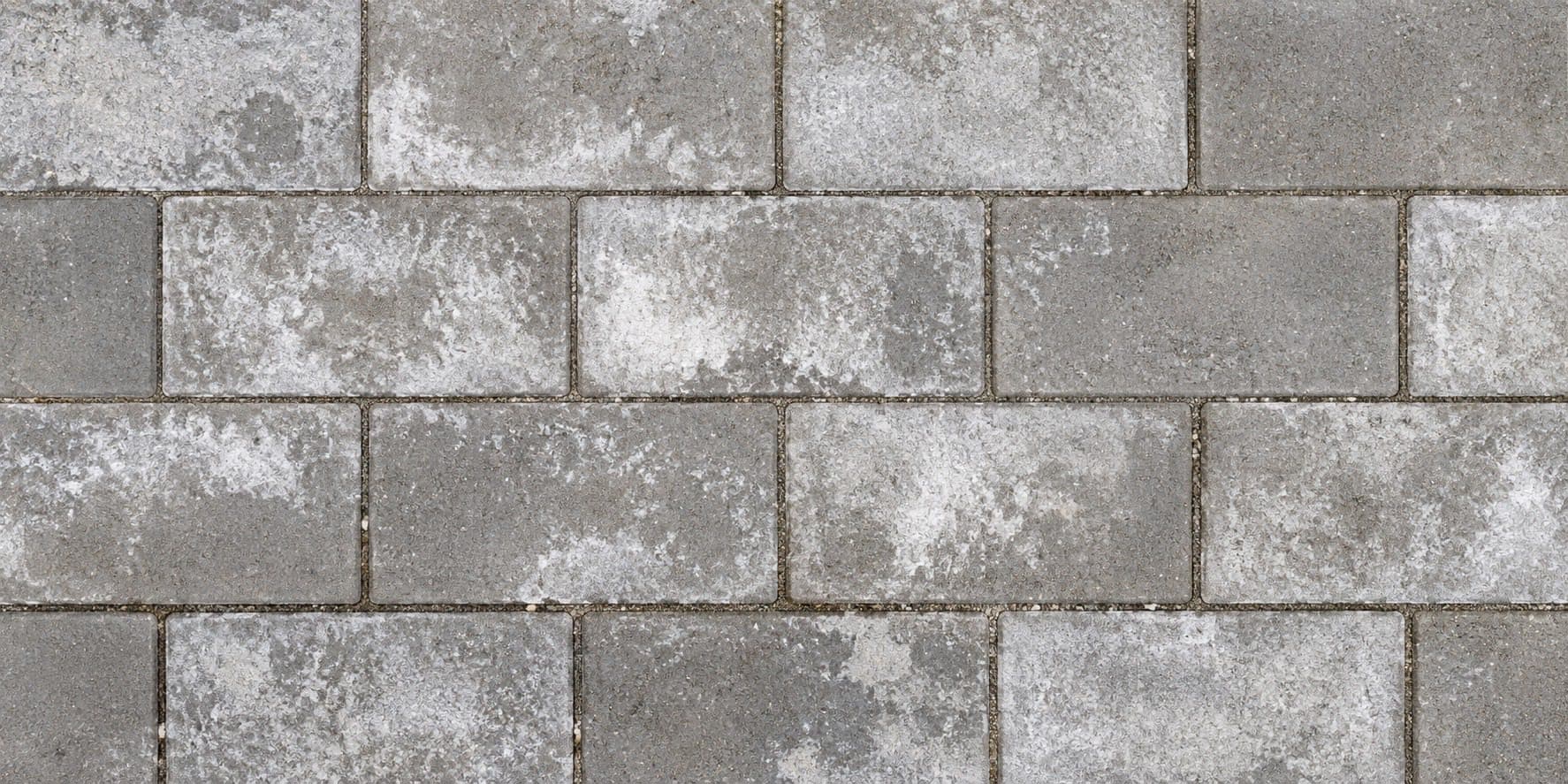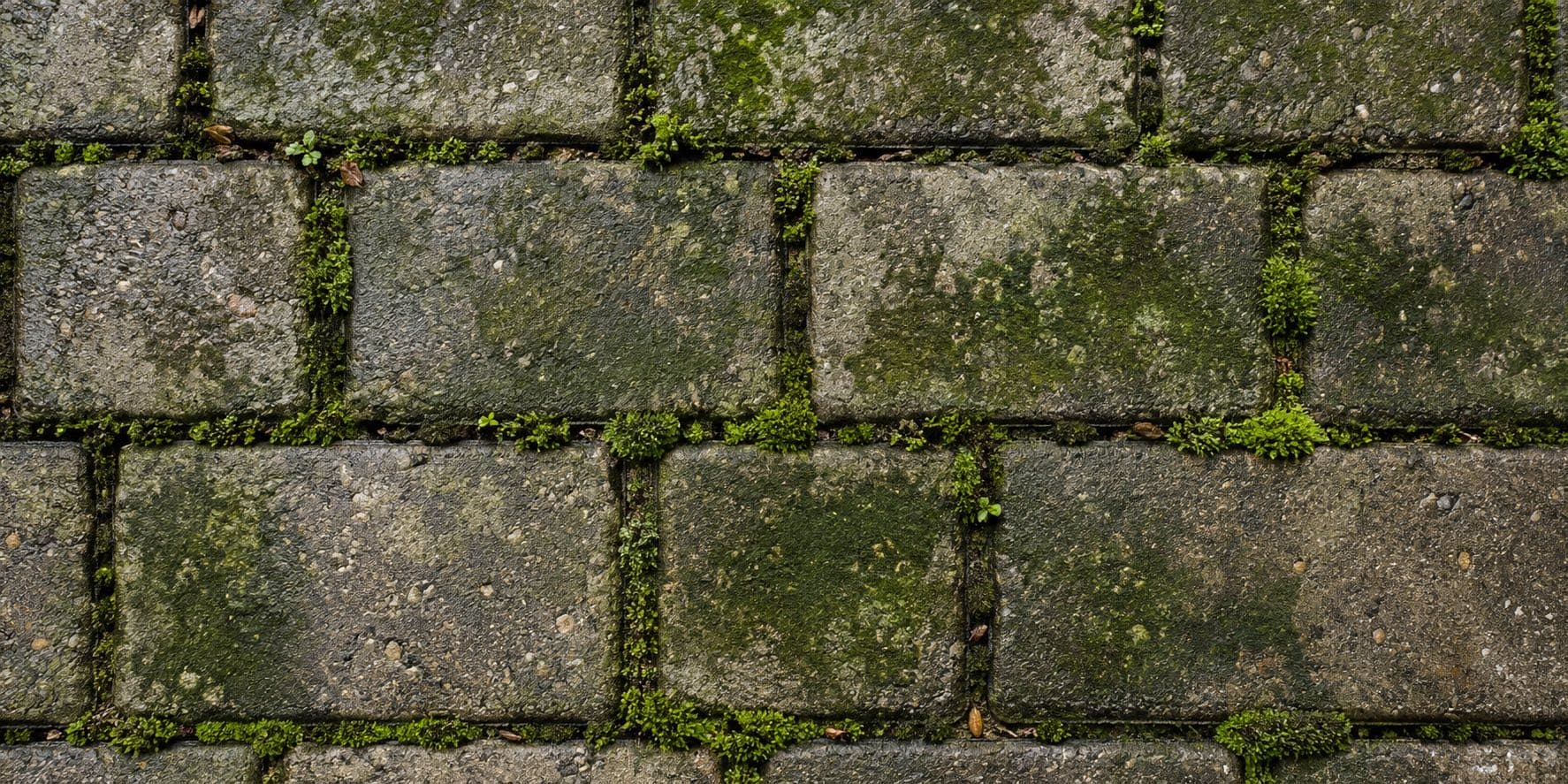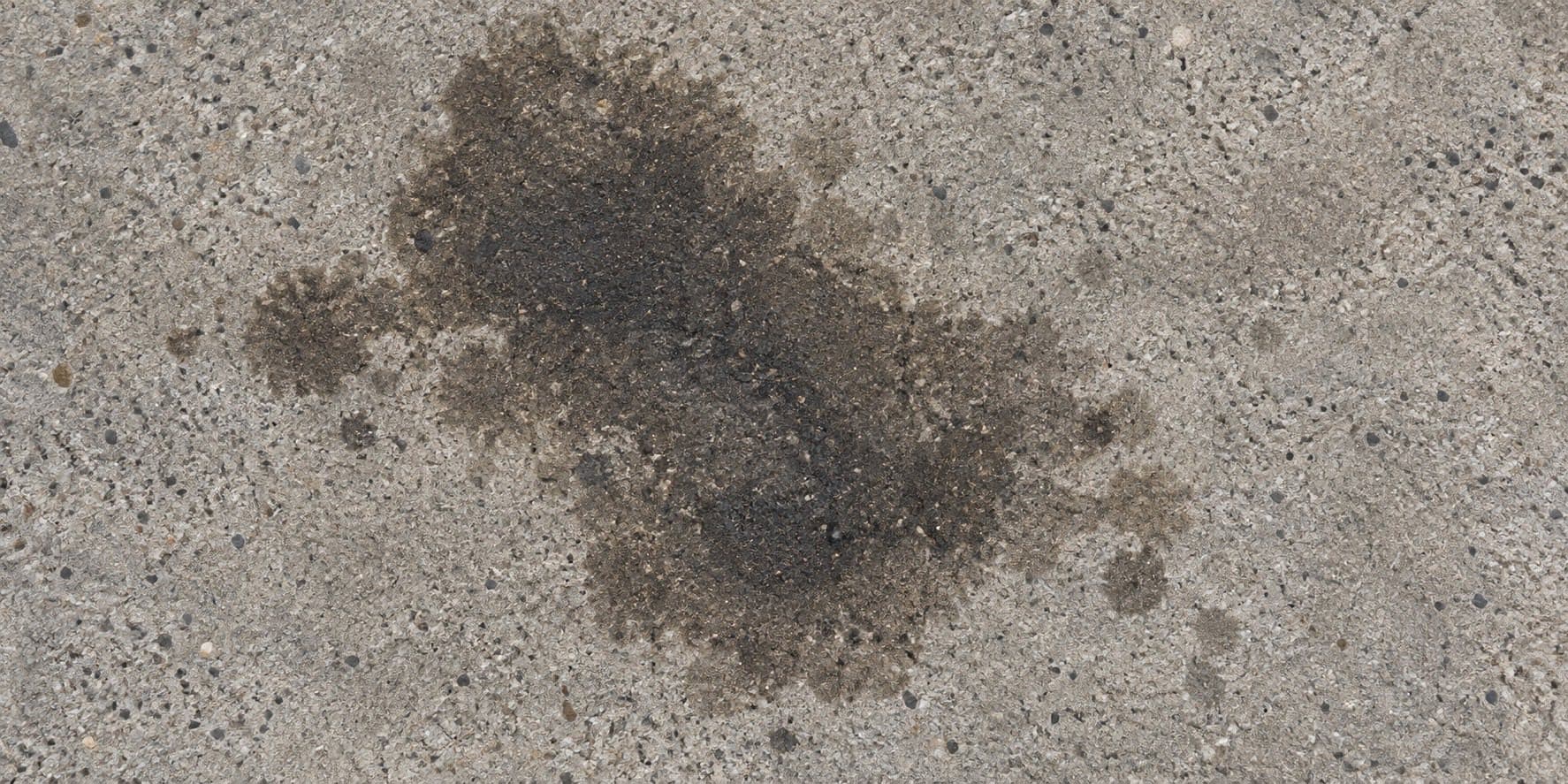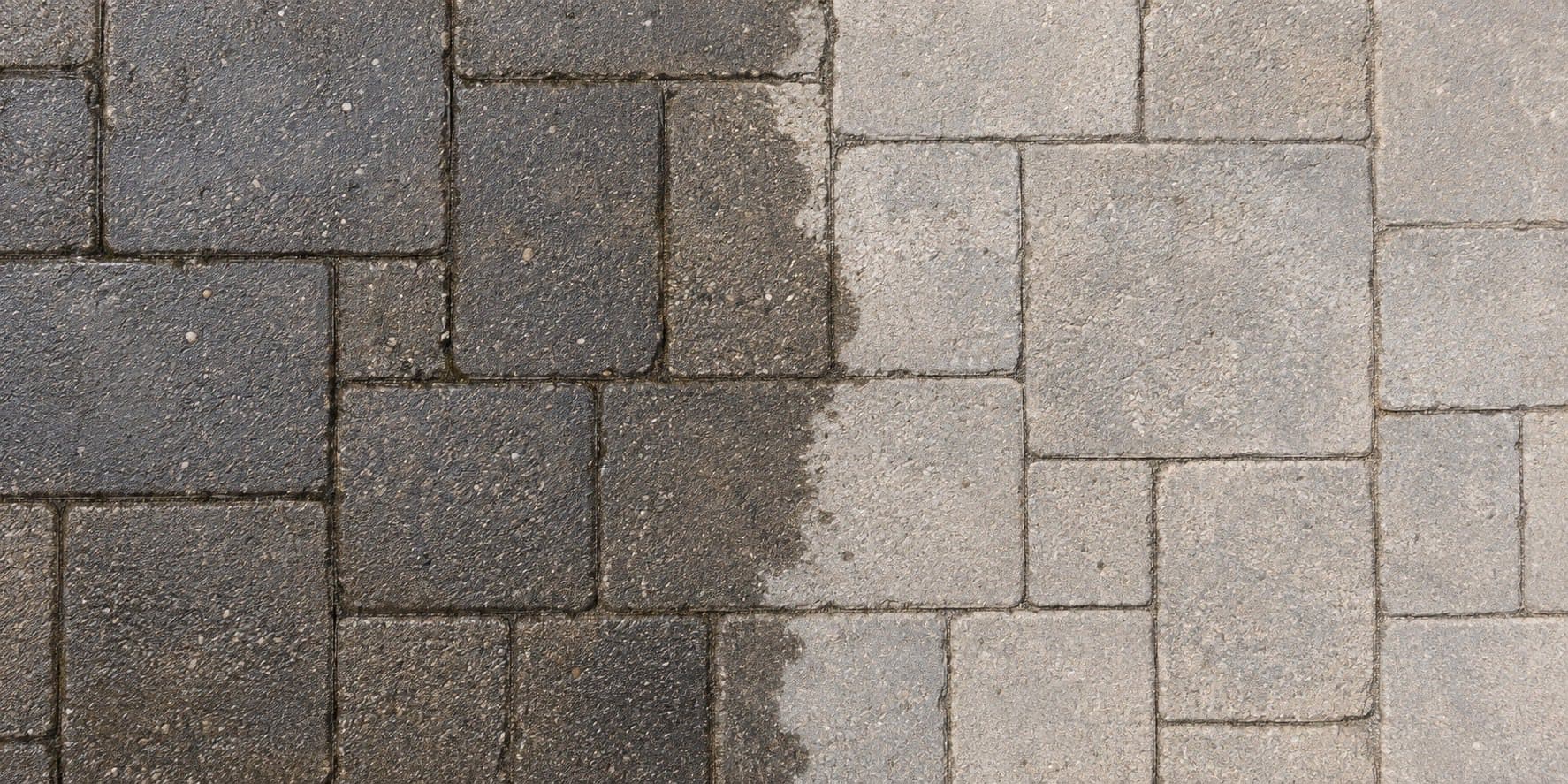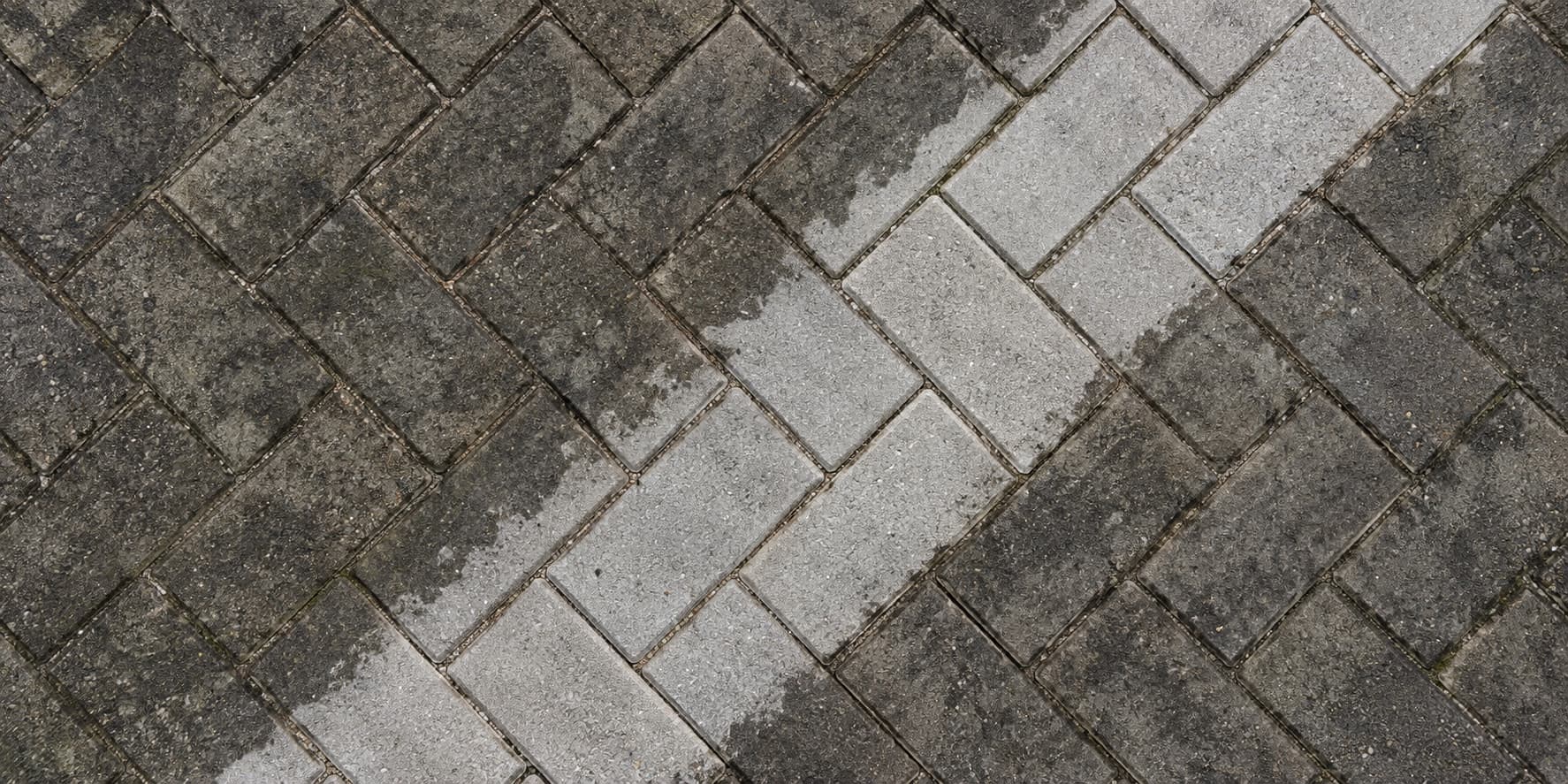
Cleaning block paving starts with one question: what is actually on it? Dust and sand come off with water and a brush. Green growth, white efflorescence, grey haze left by the build and an oil stain are four different kinds of soiling, and each one needs something different - a product made for one simply will not work on another.
Below you will learn to tell them apart, see in one table what removes each, and find the washing rules that protect the joints and the colour of your paving. For every problem we point you to a detailed guide.
In short
Identify the soiling first.
Acid dissolves mineral deposits, alkali dissolves grease and organic dirt. One product for everything is the most common reason a wash fails.
Water and a brush are enough for dirt that sits on top.
Dust, sand, leaves and mud need no chemistry.
A pressure washer helps, but it empties the joints.
Keep the pressure down and top up the jointing sand afterwards.
Before sealing, paving must be clean and dry right through.
A sealer locks in whatever it finds - bloom and stains included.
How to tell what is on your paving and what removes it
Everyday dirt and dust. A grey film, sand in the joints, darker tracks where you walk and drive most. It sits on the surface, so start by sweeping and washing with water and a brush. If the paving still looks dull and greyed, reach for the EC-87 paving cleaner - it refreshes block paving, concrete, clinker and stone and works in just 2-3 minutes. An old, greasy driveway comes clean with the alkaline concentrate D-12K for block paving.
Moss and green growth. Algae and moss grow where there is shade and damp: along a north wall, under a tree, in hollows where water stands. A cleaner for organic soiling takes the growth off, but if the conditions stay, it comes back after every wash. How to change that is covered in our guide to moss and green growth on paving.
Lime efflorescence. A white, matt bloom, most often on new paving. It is lime that water carried out of the concrete, so water and detergent will not touch it - only an acidic cleaner dissolves it. Where it comes from and whether it returns is explained in efflorescence on block paving.
Cement laitance. A grey haze, streaks and crumbs of mortar on the paving right after laying, bricklaying or cutting. It is building residue that has to come off before the first sealing. The guide how to remove cement laitance takes you through it step by step.
Oil and grease. A dark patch under the car, by the barbecue or in front of the garage. Oil soaks into the pores, so a brush does nothing and harder scrubbing only spreads it. Cover a fresh stain with sand, sawdust or cat litter first, then use a degreaser. The full order of work is in our guide to oil stains on paving and concrete.
What you see and what removes it
| What you see | What it is | What removes it |
|---|---|---|
| Grey film, sand, faded colour | Everyday dirt and dust | Water and a brush; EC-87 for heavier dirt |
| Dark, greasy driveway | Wear and organic soiling | D-12K alkaline concentrate |
| Green film, moss in the joints | Algae and moss | EC-87 or D-12K, then deal with shade and standing water |
| White, matt bloom | Lime efflorescence | Acidic D-2W or EC-22 |
| Grey haze and mortar residue after a build | Cement laitance | D-2B or Guard Remover Eco |
| Dark, greasy stain | Oil, grease | OL-1 on the spot, Net’Guard Ultra on larger areas |
| Black streaks from wheels | Tyre marks | Net’Guard Ultra 4 in 1 |
What to clean block paving with: water, a pressure washer or a cleaner?
Water and a brush. Enough for anything lying on the surface: dust, sand, leaves, mud. Sweeping away loose dirt is also the first step before any other treatment.
A pressure washer. It strips dirt and growth off paving in minutes, but it also washes the sand out of the joints, and on older paving it can damage the surface layer. An emptied joint holds moisture longer, which favours green growth. So keep the pressure down and top the joints up afterwards. Where a washer really earns its place is rinsing off cleaners - Guard Remover Eco and Net’Guard Ultra 4 in 1 are best rinsed off with one.
A cleaner. You need one when the soiling has bonded with the paving: efflorescence has come out of the concrete, laitance has hardened, oil has soaked into the pores. Water alone, even under pressure, will not do it here. Acidic cleaners dissolve mineral deposits - efflorescence, laitance and mortar residue - while alkaline ones deal with grease and organic dirt. You will find every cleaner in the cleaning and restoration category.
How to clean paving with a cleaner, step by step
1. Sweep and protect the surroundings. Clear sand and leaves, and cover plants, metal edging and painted elements before you start. The acidic D-2W and D-2B must not touch metal, paint coatings or render.
2. Do a test. On coloured paving, try the cleaner on an inconspicuous spot first. Undiluted, the acidic EC-22 can draw out colour, so on coloured surfaces you dilute it with water.
3. Apply in the right conditions. Do not work in rain or on a surface heated by the sun. Take the dilution from the technical data: D-12K is diluted with water, most often 1:4, while Guard Remover Eco and Net’Guard Ultra are used undiluted.
4. Watch the dwell time. Never let the cleaner dry on the paving - it is the most common cause of streaks after washing. Guard Remover Eco stays on for 5 minutes at most, while Net’Guard Ultra needs 15 minutes or more, depending on the soiling.
5. Rinse thoroughly. With plenty of water, ideally with a pressure washer. If you have several problems at once, remove the grease first, then the mineral deposits, and rinse everything at the end.
Block paving cleaners
Cleaners for everyday dirt, efflorescence, cement laitance and oil stains - match the product to the soiling.
-trim-01M35DD76FFBNSJGXF3H6BJB72.png&w=3840&q=75) Standard
StandardOil stain remover for concrete and paving OL-1 CTS Chemistry
55,20 zł
55,20 zł/L
 Standard
Lime efflorescence remover D-2W CTS Chemistry
35,67 zł
30,50 zł/L≈ 7,63 zł/m²
 Standard
Post-construction residue cleaner D-2B CTS Chemistry
49,20 zł
40,59 zł/L≈ 10,15 zł/m²
 Standard
Block paving cleaner D-12K CTS Chemistry
29,52 zł
27,06 zł/L
 Standard
Efflorescence and staining remover EC-22 EKSIL
39,00 zł
19,43 zł/L≈ 4,32 zł/m²
 Standard
Block paving and facade cleaner EC-87 EKSIL
97,17 zł
19,43 zł/L≈ 4,32 zł/m²
 Premium
Degreaser and cleaner for patios and driveways - Net’Guard Ultra 4 in 1
279,00 zł
55,80 zł/L≈ 6,98 zł/m²
-trim-01M35D90NJB4AGG7BRVVRBWK9C.png&w=3840&q=75) Premium
PremiumEfflorescence and cement laitance remover - Guard Remover Eco
53,00 zł
41,80 zł/L≈ 6,97 zł/m²
Cleaning before sealing
If you plan to seal after washing, a clean surface matters twice over. A sealer soaks into the pores together with whatever is left in them and locks it in - bloom, grease or laitance then stay for years, and removing them means stripping the sealer. There is only one order: wash, rinse, dry, seal.
Not just the surface but the pores must be dry. New paving also needs time to give off its mixing water - with some sealers that is 28 days. Every condition is covered in our guide preparing the substrate before sealing, and once the surface is ready, see how to choose a block paving sealer. On new paving, a convenient first step is Guard Remover Eco, which needs no neutralising after rinsing.
Common questions
How often should block paving be cleaned?
Sweep and rinse with water through the season as often as you need. Reach for a cleaner when the paving has lost its colour or a bloom or stain has appeared. Deal with oil stains straight away - a fresh one comes off far more easily than one that has soaked in. Sealed paving absorbs less and is easier to keep clean afterwards.
Can I clean paving with vinegar or baking soda?
They sometimes help on small, fresh marks, but they are hard to control: the strength is a matter of chance, and on coloured paving an acid can leave the surface dull. A ready-made cleaner comes with a set dilution, dwell time and a list of the surfaces it is made for.
Does a pressure washer damage paving?
It can wash the sand out of the joints and, on older paving, damage the surface layer. Keep the pressure down and top the joints up with sand afterwards. On oil stains a washer does not replace a cleaner - use it after the cleaner, to rinse.
Will a paving cleaner harm the joints or my plants?
Acidic cleaners act on the cement binder, so with fresh or washed-out jointing, test them on a small patch first. Keep any cleaner at working strength away from planting - cover plants before you start.
How do I remove asphalt, paint or rust from paving?
These need a separate approach. Do not use equipment bitumen removers on paving - the solvent can carry the bitumen deeper into the concrete. Write to us with a photo of the stain and we will tell you where to start - we reply within 24 hours.