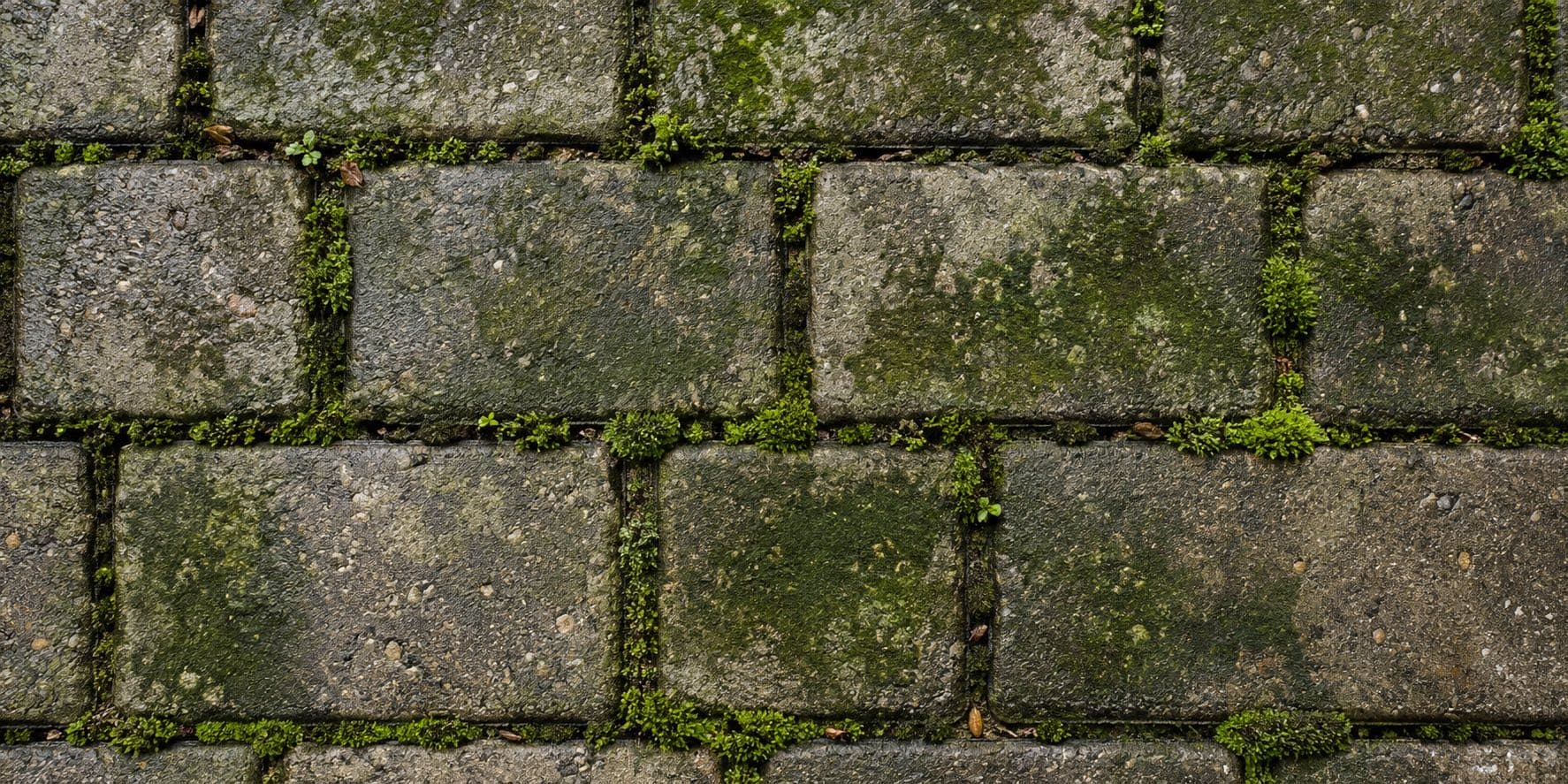
Green growth on paving, a terrace or a north-facing roof slope is algae, moss, or both. They grow where three things come together: moisture, shade, and a surface to hold on to. Take any one away and the problem goes on its own; leave all three and it comes back after every wash.
Which is why this guide starts not with a preparation but with the question of why here. Washing is easy. What lasts is what you do about the cause.
In short
This is not dirt carried in from outside.
Algae grow in place, so they return exactly where the conditions are unchanged.
Shade and standing water are the cause.
Drainage, a cut-back shrub and a cleared gutter do more than a litre of anything.
The slipperiness goes with the growth.
If a surface is slippery only after rain and in shade, that is usually biofilm, not the material.
A sealer is not a moss treatment.
A less absorbent surface can be less hospitable, but that is not the same as a remover.
Cause first, preparation second
Walk the area and check three things. Does water leave? A puddle still there a day after rain is a ready-made habitat. Does sun reach it? A branch over a terrace keeps it damp all day. Is something running down onto it? A leaking gutter or sill makes a vertical green band no preparation will stop.
That sounds like generalities, but the difference is measurable: with the cause removed, washing lasts several years; with it left in place, every season, at the same cost each time.
Where it grows and what that usually means
| Place | Usual cause | What beats washing |
|---|---|---|
| Paving against a north wall | Shade all day | Cutting back planting, if that is what shades it |
| A band along a gutter or sill | Water running down from above | Fixing the leak |
| A hollow in a terrace | Water standing after rain | Improving the fall or the drainage |
| Joints between slabs | Moisture held by the joint | Topping up and compacting the joint |
| North-facing roof slope | Shade and slow drying | Usually the clean itself; the conditions will not change |
What to wash it with
For removing growth from facades and roof tiles the catalogue carries two CTS Chemistry products: C-11E for facades and C-11D for clay and concrete roof tiles. On horizontal surfaces, where algae come with other organic soiling, manufacturers describe D-12 and EC-87 for the job.
Let us be plain about what we do not have: a product described purely as a moss treatment. If that is what you are looking for, the above are the closest the catalogue comes - and the scope of use for each is in its data sheet, under the manufacturer's name.
Preparations for green growth
What the catalogue describes for organic soiling and facade washing.
- Premium
Solvent-based block paving sealer, wet look SK-2 CTS Chemistry
60,27 zł
54,12 zł/L≈ 7,22 zł/m²
- Standard
Facade and render cleaner C-11E CTS Chemistry
20,66 zł
19,43 zł/L
- Standard
Roof tile cleaner C-11D CTS Chemistry
33,21 zł
24,35 zł/L
- Premium
Solvent-based sealer for concrete fencing EI-13 EKSIL
232,47 zł
46,14 zł/L≈ 5,43 zł/m²
- Standard
Silane facade sealer that deepens colour EH-16 EKSIL
145,00 zł
25,75 zł/L
- Entry
Water-repellent sealer for facades, roofs and paving - ImperGuard Ultra 4 in 1
269,00 zł
53,80 zł/L≈ 6,73 zł/m²
Does sealing help
Indirectly, and with no guarantee. Moss needs moisture, so a surface that absorbs less and dries faster can be less hospitable to it - manufacturers describe limiting water uptake as the main use of this group. It is not a biocide, though, and we do not promise the growth will stay away: with standing water and full shade it will return regardless.
If you are doing both, the order is fixed: remove the growth, then dry and prepare the substrate, and seal last. A sealer applied over algae will shut them in underneath.
Common questions
Does moss damage block paving?
The growth itself is mostly a matter of appearance and slipperiness. Moss roots can widen joints, though, and the moisture they hold feeds into what happens to the surface over winter. Whether and how fast depends on the sub-base and the drainage.
Will soda or vinegar remove moss from paving?
On small areas they sometimes work, but they are hard to control, and on coloured paving and limestone acids can do damage. Catalogue preparations come with a stated dilution, dwell time and list of permitted substrates.
How often does it have to be repeated?
As often as the conditions return. With drainage improved and sun let in, it can be every few years; in permanent shade over standing water, every season. Which is exactly why this guide starts with the cause.
Can roof tiles be cleaned without going on the roof?
Some roof tile preparations are described by their manufacturers as sprayed from a ladder or a platform. The conditions of use and the method are in the data sheet for the specific preparation. Working at height is its own risk - on steep slopes it is more sensible to have it done.
Is green growth the same as efflorescence?
No. Efflorescence is white and comes from inside the concrete; growth is green and lives on the surface. They are removed with different preparations - we gave efflorescence a guide of its own.