Wet-look stone sealer, matt - ProtectGuard WL Mat

An acrylic sealer for brick, terracotta, natural stone and concrete that deepens the colour of the substrate and leaves a matt, wet-look finish. It protects against water, oil and staining, forms no film and does not close off vapour permeability.

Surface

Block paving

The surface the manufacturer intends this preparation for.
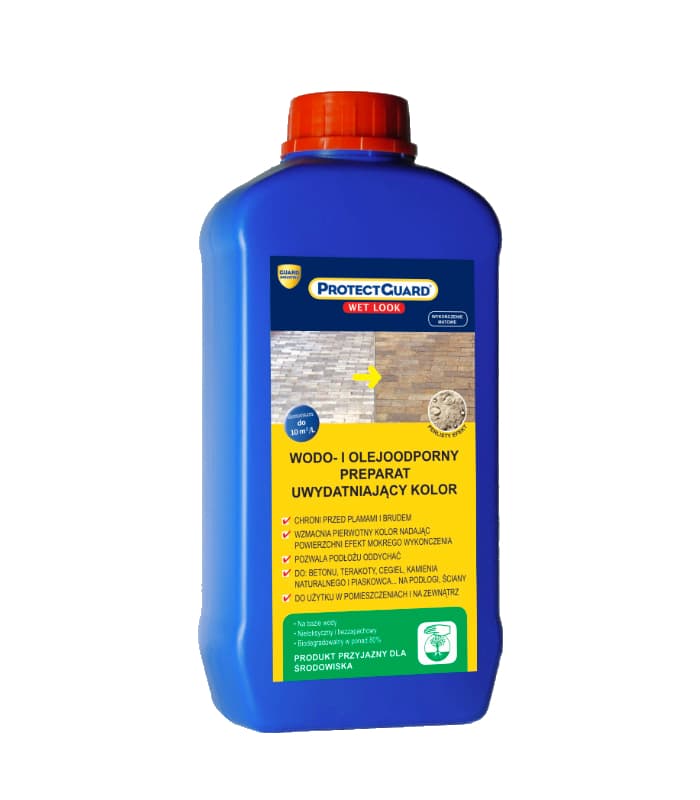
Demonstration product image: Wet-look stone sealer, matt - ProtectGuard WL MatBlock paving

ProtectGuard WL Mat belongs to the Wet Look range: its job is to deepen the colour of the material rather than leave it unchanged. Brick, terracotta, sandstone and concrete look as they do after rain - except that here the effect stays.

The only thing separating it from its twin, WL Semi-gloss, is the finish. Matt gives a saturated colour without reflections and is the safer choice where the surface is uneven: gloss on old brick or split stone picks out every irregularity, matt visually smooths it.

The manufacturer states 10 m² per litre and application in two coats 15-30 minutes apart, depending on the porosity and temperature of the material. The surface is dry after a day, and the final appearance settles after 5-7 days - judging the colour earlier can mislead.

The usual reason a sealing job fails is not the product but the substrate. A sealer will not bond to a surface with grease, lime efflorescence or an old coating on it.

  1. Wash the paving. Lift oil stains with a degreasing cleaner - water alone, even under pressure, will not shift them.
  2. Remove lime efflorescence with a product made for it, not with hydrochloric acid from the builders' merchant.
  3. Make good the joints and let them set. Sealer applied over an empty joint runs straight into the sub-base.
  4. Wait until the paving is dry all the way through, not just on top. Moisture trapped under the film can bloom it white.
  5. Check the forecast. Rain within a day of application will wash off a fresh coat.

New paving has to season first. Manufacturers state that period on the data sheet - usually around 28 days from the date the block was made. The figure for each product is under "Technical data".

Before sealing the whole area, test on a patch hidden by a planter or in a corner of the patio. The same product can read differently on two batches of the same material, and on a surface with old coating left on it, it will not bond at all.

Coverage
10 m²/l
Coats
2
Finish
wet look
Application method
low-pressure sprayer, roller, brush
Dilution
Do not dilute
Drying time
1 day
Full cure
7 days
Where to use
indoors, outdoors
Recommended substrates
brick, terracotta, natural stone, concrete, sandstone
Interval between coats
15-30 min, depending on porosity and temperature
Final appearance
deepened colour, matt finish
Manufacturer's pack sizes
750 ml, 5 l, 10 l, 25 l
Will the sealer change the colour of my paving?

That depends on the finish given in the technical data. An invisible product leaves the colour alone, a wet-look version deepens it permanently, and a colour sealer gives it a new shade. Each product's finish is listed under "Technical data".

How do I know when to seal again?

By how the water behaves. While it still beads on the surface, the treatment is working. Once water starts soaking in and dark patches return after rain, the protection has worn out. We do not quote a number of years, because it depends on traffic, sun and whether the drive is salted in winter.

Can I apply sealer to wet paving?

No. Water occupies the pores the product is meant to enter, and stays trapped under the film. The result is often a milky bloom that cannot be removed without stripping the coat. The exceptions - products that allow slight surface dampness - say so in their technical data.

How much do I need to buy?

Use the calculator under the product description: it takes the manufacturer's coverage figure, the number of coats and the absorbency of the substrate, and turns them into pack sizes. On older, thirstier paving, work to the lower end of the coverage range.

Will sealing make the paving slippery?

Penetrating products form no film on the surface and do not change its grip. Where a manufacturer says something about slipperiness, we quote it in the technical data. If the surface is already slippery, the right product is an anti-slip treatment, not a sealer.

Matt or semi-gloss?

Matt if you want saturated colour without a sheen, and if the surface is rough or uneven. Semi-gloss where the material is smooth and is meant to shine as well. Protection against water, oil and staining is the same job in both; only the finish differs.

Is it suitable for a brick floor indoors?

Yes - the manufacturer lists brick on floors and walls among the recommended substrates, indoors and out. Terracotta and brick are the materials where the deepening of colour shows most.

What happens if I apply too much?

Any excess that does not soak in dries on the surface as a glossy patch or as runs. The manufacturer says to lift the excess before it dries - which is why you work thinly and in sections, not generously.

The technical sheet and safety data sheet will be available after approval.

Coverage calculator

Enter the area and how absorbent the substrate is. We work out the litres and the packs.

The manufacturer's figure is for one coat; an absorbent substrate will take more.

Substrate absorbency

Calculated at 10 m² per litre.

Example for 45 m²

9L

  • 1 × 5 l729,00 zł
  • 4 × 1 l636,00 zł

Enter your own area to calculate for your job.

Related products

Looking for another surface?

Go directly to the right category. We do not imply compatibility across materials.